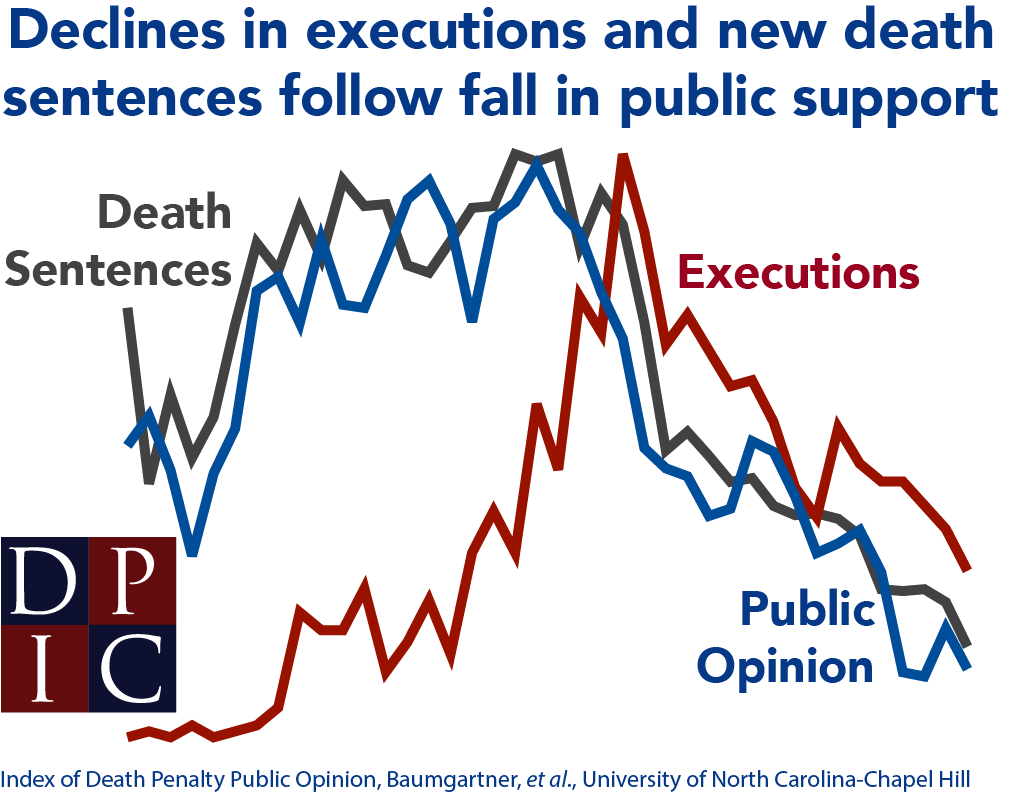
What’s Going On Here?
Here’s the question: is the death penalty becoming less acceptable to the American Public — or is the decline a result of the inability of states to execute efficiently with the lethal injection method of execution?
What’s Going On Here?
Here’s the question: is the death penalty becoming less acceptable to the American Public — or is the decline a result of the inability of states to execute efficiently with the lethal injection method of execution?
The Death Penalty Information Center released its new report, "Death Penalty in the United States," this week.
New DPIC Report on Death Penalty in the United States in 2015
You can read the full text of the report online here.
Among its key findings are:
• There were 28 executions in 6 states, the fewest since 1991.
• There were 49 death sentences in 2015, 33% below the modern death penalty low set last year.
• New death sentences in the past decade are lower than in the decade preceding the Supreme
Court’s invalidation of capital punishment in 1972.
• Six more former death row inmates were exonerated of all charges.
Watch the Video Summary of the DPIC Findings
Here’s a short video that gives you a full summary of the DPIC report’s contents:
https://youtube.com/watch?v=In90IQ-fTbE

Wow. Gathering together data from the Death Penalty Information Center as well as pre-1976 data from M. Watt Espy and John Ortiz Smykla, Time Magazine (hat tip to Chris Wilson, Emily Maltby and Lon Tweeten) has put together a really amazing compilation regarding the death penalty in America.
Go here to read, " Every Execution in U.S. History in a Single Chart."
You’ll learn a lot.
Like there have been executions in this country by burning people to death.
And the most popular form of execution in the USA? Hanging.
Worth your time to peruse and ponder.
Yesterday, the State of Georgia executed Brian Keith Terrell for the June 1992 killing of John Watson.
Terrell was convicted of murdering Watson after Watson demanded Terrell pay him back after Terrell forged some of Watson’s checks.
It was an execution by lethal injection. There are many who argue that Terrell was innocent of the crime. There are others that argue there may have been prosecutorial misconduct during his trial.
For more on these details, check out the CBS News article detailing Terrell’s case.
Meanwhile, the National Execution Calendar for 2015 is complete. No more executions will take place this year.
We have seen 28 people die as capital punishment in the United States this year. Interesting point made by NPR: this is the same number of deaths as those who died from lightening strikes.
For the complete list of 27 men and 1 woman who were executed in this country during 2015, all by lethal injection, check out the DPIC list.
The 2015 American Values Survey by the Public Religion Research Institute has been released regarding capital punishment.
The researchers asked 2,695 Americans what they thought about the death penalty. (Click the above link to read the entire study.)
Here’s a great infographic from Death Penalty Information Center that summarizes the findings.

As discussed in our prior post, Terry Lenamon and the Florida Capital Resource Center he co-founded years ago work hard to help not only those facing the death penalty, but the lawyers out there who undertake the job of defending a capital case.
This means that the FCRC will provide seminars and training to Death Penalty lawyers at no charge to them. For instance, this past summer the Center offered a two-day training seminar in jury selection by the Honorable Carey Haughwout, Public Defendner for the Fifteenth Judicial Circuit.
Now, Terence Lenamon is announcing another seminar in this ongoing effort to help capital lawyers.
FLORIDA DEATH PENALTY LAWYERS SEMINAR
Terence Lenamon is offering a single day training course around Florida to attorneys in the Sunshine State who represent defendants in capital cases.
Death Penalty Lawyers please note that these are free seminars in defending capital cases offered by Board Certified death penalty defense attorney Terry Lenamon for which you can receive Continuing Legal Education credit.
Hours are 10 am to 4 pm for each seminar.
6 HOURS FREE CLE
Locations and dates:
Miami – 11/18
Public Defender Office
Bushnell 12/01
Public Defender Office
Tampa 12/4
Public Defender Office
Fort Lauderdale 12/7
Public Defender Office
Ocala 12/8
Public Defender Office
Jacksonville 12/9
Florida Coastal School of Law
Pensacola January 2016 (To Be Announced)
When I asked Terry what he thought about the recent Slate article, “ The Worst Lawyers: Death sentences are down across the country—except for where one of these guys is the defense attorney,” he said that what law professor Stephen Bright wrote twenty years ago is still true today: all too often, the death penalty is handed down not “for the worst crime, but for the worst lawyer.” (Bright is quoted in the Slate article).
It goes without saying that capital punishment is sought in cases where all too often, the defendant is indigent. That means that they are appointed counsel as their constitutional right.
In what situation can you imagine where it’s more important to have a dedicated, compassionate, experienced, and smart lawyer than in a case where the prosecution is seeking the death penalty?
Yet all too often, as Terry pointed out, there are some very bad (I won’t use his exact adjectives; explicatives deleted) lawyers out there who are all too happy to take on capital punishment representations.
That’s one end of the continuum. But there IS a continuum.
Some of the Best and the Brightest Defend Capital Cases
There are lawyers in this country who are dedicated to representing people who are facing death penalty convictions (or are trying to have death penalty sentences reversed on appeal). They are not choosing this practice area because they want money or glory — if they were, there are plenty of other areas of the law that are better suited to those goals.
They made a choice. Or maybe their hearts made the decision for them.
These are top-notch lawyers who enter a courtroom where the battle isn’t for money or years behind bars: it’s life versus death. They are passionate — and very good at what they do.
Yes, the Slate article is right. But it’s not the whole story.
Good lawyering is paramount in capital cases; and while there are bad lawyers representing defendants in capital cases, you will find some of the most honorable and (yes) noble of our profession are doing the same thing.
Do You Know About the Florida Capital Resource Center?
Like Terence Lenamon. Like those that work for and/or support the non-profit organization Terry co-founded, the Florida Capital Resource Center.
Maybe you know a few names to add to that list; feel free to share them in the comments.
From the Florida Capital Resource Center website:
History & Overview | Where we began & where we are going…
Florida Capital Resource Center was founded in 2009 by Terence "Terry" Lenamon, a renowned capital defense attorney in Miami, Florida, and Cynthia "Cindy" O’Shea, a talented defense attorney-turned-mitigation specialist who works with Terry on many of his capital cases.
Terry and Cindy believed that Florida’s capital justice system was (and still is) in a state of emergency because capital defense attorneys are often underfunded, under-qualified, or simply unmotivated to provide effective representation, particularly in cases involving indigent defendants.
Though vast amounts of taxpayer dollars are spent on the administration of Florida’s death penalty, budget cuts and poor legislation have reduced critical public defender resources and act to discourage talented private attorneys from registering for court-appointment.
To help counter that growing and alarming problem, Terry and Cindy decided to create a nonprofit organization that would provide a place where capital defense attorneys could find death penalty-related information and trial materials. They commissioned a website designed to house a clearinghouse of materials, and those materials are constantly expanding.
Since its inception in 2009, FCRC’s mission has expanded and its goals have broadened. Today, the mission of Florida Capital Resource Center is to assist indigent defendants facing the death penalty by providing consultation, research, training, advocacy, and other necessary resources to capital defenders state-wide.
Recognizing the "uneven playing field" inherent in the defense of impoverished individuals on trial for their lives (and the gross limitations of post-conviction remedies, even in the most constitutionally-violative cases), FCRC attempts to ensure that long-standing inequities are mitigated or abolished.
FCRC operates in multiple venues, including standing with those seeking statutory and rule changes intended to remove injustice from all relevant aspects of death penalty law and practice.
Working with other organizations (both local and national), FCRC seeks to protect the constitutional rights of Florida’s capital defendants by increasing access to critical resources, thereby improving the level of representation provided by Florida’s capital defense bar.
Here’s the question: are controversies surrounding the drug or drugs used in lethal injection executions enough to halt capital punishment altogether? Even though there are other, legal methods of execution on the books?

Consider the following three examples of executions not going forward because of drug issues:
1. Missouri Execution Halted Over Pentobarbital Issue In Man With Brain Tumor
Yesterday, the United States Supreme Court ordered the execution of Ernest Lee Johnson by the State of Missouri be stayed while legal issues are resolved in his case. The stay was none too soon: Johnson was scheduled to die yesterday.
The first issue: if the lethal injection method will be cruel and unusual in his case because of the pentobarbital used by Missouri (source unknown) might interact with his brain tumor and cause painful seizures. The second issue: whether or not this man should be executed because he suffers from mental disabilities. (His IQ has been tested at 63.)
2. Ohio Delays Executions Until 2017
Ohio can’t find drugs to use in its lethal injection executions. So all the inmates on Ohio’s Death Row have received a stay of sorts: now, Ohio’s execution schedule begins in January 2017 and continues through August 2019. There are 25 executions scheduled during this time period.
From its Department of Rehabilitation and Correction (go here for full release including revised schedule with individual dates and names):
Today the Ohio Department of Rehabilitation and Correction (DRC) announced revised execution dates for twelve inmates. DRC continues to seek all legal means to obtain the drugs necessary to carry out court ordered executions, but over the past few years it has become exceedingly difficult to secure those drugs because of severe supply and distribution restrictions. The new dates are designed to provide DRC additional time necessary to secure the required execution drugs.
3. Oklahoma Delays Executions At Request of Attorney General
We all know that Oklahoma has had some serious problems with the lethal injection method of execution. After all, Glossip v. Gross comes out of Oklahoma — where Richard Glossip, Benjamin Cole, and John Grant, challenged the use of midazolam in the three-drug lethal injection cocktail, arguing that three executions showed that the drug failed to stop pain. SCOTUS ruled against them back in June.
It was also Oklahoma where Richard Glossip just had his execution stayed at the last minute by the Governor.
Why? Apparently, they were about to use the wrong drug in the execution, potassium acetate. The correct and approved drug for lethal injection in Oklahoma is potassium chloride, NOT potassium acetate.
Even more disturbing: Oklahoma officials are now acknowledging that the wrong drug, potassium acetate, was used in the January 2015 execution of Charles Warner.
This is the same state that botched the execution of Clayton Lockett, remember.
Now, Oklahoma executioners face a revised execution schedule that delays any executions. The Attorney General for the State of Oklahoma has asked that all executions be stayed there until they can get this drug problem resolved.
We’ve discussed this in prior posts, but lots of people forget that there are legal and SCOTUS-approved methods of execution on the books in Florida, Texas, and other states other than lethal injection.
Old Sparky Stands Ready
In Florida, execution by electrocution using an electric chair nicknamed "Old Sparky" remains a constitutionally acceptable method of capital punishment. And while Old Sparky hasn’t been used in 16 years, it’s still available to the State of Florida.
No one has dismantled Old Sparky.
For more on the historical use of the electric chair in U.S. executions, read our earlier post Electric Chair Executions: Consider This Historical Alternative to Lethal Injection.

Doty’s Request to Circumvent Lethal Injection Method Is Logical
Which means that when Florida Death Row inmate Wayne Doty requested that the electric chair be the execution method used for him, he was pretty savvy. There’s no legal controversy pending before the Supreme Court of the United States over the electric chair like there is lethal injection methods and procedures.
Wayne Doty wants to be executed as soon as possible for his "spiritual freedom." By opting for the electric chair, he has a much higher chance of achieving that goal because he’s circumventing all the constitutional fights over lethal injection as an execution method.
Whether or not Mr. Doty’s request to be executed as soon as it can be arranged will be respected has yet to be decided. The court must confirm his mental health status in making this kind of request, for one thing.
Most Death Row inmates fight to live — having a Death Row inmate fight to die does bring his mental health into question.
As for what will happen to Wayne Doty’s request to be executed in Old Sparky, it’s too soon to tell.