The United States Supreme Court has stayed the execution of Herbert Smulls by the State of Missouri, but the argument isn’t because Missouri is doing some strange new combination of untested drugs in a lethal injection method – no, the argument surrounds whether or not the identity of the supplier of pentobarbital must be revealed.

Obviously, lots of people would like to know who is providing pentobarbital to Missouri, since the lack of supply of this drug for lethal injections in other states has led to Ohio and Florida and other states finding new alternative drug cocktails in order to execute people.

(For more information, read our earlier posts regarding the recent Ohio, Oklahoma, and Florida execution processes.)

Meanwhile, news is that other states are considering other forms of execution as lethal execution methods get so difficult based upon drug supply issues.

This wouldn’t be so hard to do as some might think:  many states have valid laws on the books for executions by firing squad, gas chamber, electric chair, and hanging.  See our earlier posts for details. 
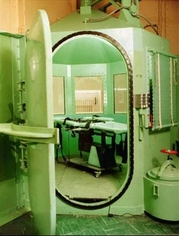
Image above:  Gas Chamber used for Executions

Image: Terence Lenamon in foreground, with client Andrew Castor and Terry’s co-defense counsel, LenamonLaw’s Melissa Ortiz, during trial. Photo by Marisa Kendall / The News-Press

____________________

Pictured above is Terry Lenamon at work during the recent trial of Andrew Castor over in Cape Coral, Florida.  The death penalty was taken off the table early on in the case; the jury came back with a guilty verdict last week. 

For Terry, this latest trial is just one more in his list of criminal cases going back many years.  He’s adept at trying cases, and he has built a practice out of defending people facing the death penalty – particularly, those facing capital punishment in the State of Florida.

Florida is about as well known as Texas for executing people and sentencing folk to death.  Needless to say, Terry is a busy man.

However, what lawyers in Texas and lots of other attorneys and members of the general public may not know is that Florida gives Terry an even bigger burden than his colleagues in other states might face.

What’s the big deal about Florida death penalty defense?  Well, it’s the juries.  In Florida, it is not necessary to have 100% agreement of all the jurors in order for someone to be sentenced to death.  Nope.

Florida does not require the entire jury to support the death penalty for the death penalty to be sentenced in a case. 

This summer, Florida State Senator Thad Altman proposed legislation to the Florida Legislature that, if passed, would have required Florida juries to be unanimous before the death penalty could be imposed.  Altman’s bill never made it out of committee.

Which means, for Terence Lenamon and others in the position of setting at a Florida defense table, as he’s doing in this photo, the defense has the job of convincing most of those jurors, not just one or two (like in Texas where an unanimous agreement among jurors for death penalty is required). 

Dennis McGuire was executed by the State of Ohio using a new two-drug combination that had never been used in an execution in Ohio, or anywhere else for that matter.  Many warned about the possibility that this lethal injection method would be the very cruel and inhuman type of death that the U.S. Constitution prohibits.

Ohio went ahead anyway. 

Now, media reports are quoting witnesses to the execution that Dennis McGuire didn’t pass away on that gurney quickly or quietly.  For 10 minutes, witnesses watched as McGuire choked for breath, gasping and straining against the restraints, struggling for air.

Included among those witnesses were his federal public defenders, his daughter, son, and daughter-in-law. 

Watch Columbus Dispatch reporter Alan Johnson’s recounting of what he saw here.

Of course, McGuire had been convicted of a violent crime – but comparing the death for which he was convicted with the death he had to endure in his execution is missing the point here.

Constitutional protections exist to prevent inhumane executions by the government and in states like Ohio and Oklahoma (remember Wilson’s "I feel my whole body burning" last week"?) where these untried drug combinations are being used in capital punishment – well, it’s beyond shocking and no one should be surprised that there are calls now for an immediate moratorium on the death penalty in Ohio now.

As for his children?  They are reportedly suing in federal court for the wrongful death of their father in this execution. Watch the Johnson video above for details here.

The State of Oklahoma executed Michael Lee Wilson yesterday by lethal injection.

News media reports are that almost immediately after the injection process began (within 20 seconds), Wilson said, ‘I feel my whole body burning  yet his body didn’t react in such a way that any of the witnesses could see his body reacting to the drugs.

According to the State of Oklahoma’s site, the drugs used in Oklahoma executions are:  (1) Sodium Thiopental or Pentobarbital – causes unconsciousness; (2) Vecuronium Bromide – stops respiration; and (3) Potassium Chloride – stops heart.

Thomas Knight Executed Using Midazolam Hydrochloride by State of Florida

Just the day before, the State of Florida executed Thomas Knight after he lost his fight against the lethal injection execution method used by Florida executors which involved a new drug, midazolam hydrochloride, because Florida had run out of pentobarbital. 

Knight’s lawyers argued that the lethal injection method was unconstitutional because these new drug cocktails have not been medically and scientifically shown not to be cruel and unusual means of executing people. 

Ohio Fight Over 2-Drug Execution Method for Dennis McGuire Lethal Injection

Meanwhile, in Ohio, there’s a fight because Ohio wants to use the drug that Florida used in the Knight execution, midazolam hydrochloride, with one other drug — a TWO drug cocktail — to execute Dennis McGuire.  Medical experts and attorneys are fighting in federal court on the constitutionality of this new lethal injection method. 

Does any of this bother you? 

The Florida Supreme Court issued its ruling in the use of midazolam hydrochloride as part of lethal injection executions this week.

Read the opinion in its entirety here. From their decision:

We acknowledge that, as we explained in Lightbourne, if the inmate is not fully unconscious when the second and third drugs, vecuronium bromide and potassium chloride, are dministered, the inmate will suffer pain. See Lightbourne, 969 So. 2d at 351. However, we agree with the circuit court that Muhammad has not demonstrated that the conditions presenting this risk are “sure or very likely” to cause serious illness or needless suffering and give rise to “sufficiently imminent dangers” under the standard set forth in Baze. Thus, we reject his constitutional challenge to the use of midazolam hydrochloride in the lethal injection procedure.

..

A documentary worth your time to watch, here’s the description from YouTube:

Robert Sullivan (EXECUTED), Dane T. Gafford (Danny Gafford( (INCARCARATED), and Dennis Whitney (DIED A PRISONER) tell their stories about the DEATH PENALTY and is it right or wrong. Filmed in 1980, “On Location: Death Row Florida State Prison”, represents the first time ever that cameras were allowed on Death Row. Well known Producer/Director/Cinematographer and editor Ron Jones tells his story of his visit, along with reporter Beth Lawrence, deep inside Florida’s Death Row.

Last month, the Florida Supreme Court (5-2) ordered that the December 3, 2013, execution of Thomas Knight (aka Askari Abdullah Muhammad) – which had been approved by Florida Governor Rick Scott – be stayed after hearing arguments from defense counsel regarding the proposed use of midazolam hydrochoride as part of the drug cocktail that would be used by the Florida executor in the lethal injection.


The stay was ordered and a hearing was ordered, too.

The Florida Supreme Court ordered that a judge in Bradford County hold an evidentiary hearing on the drug midazolam hydrochloride and whether or not it is safe and effective for use in killing human beings as part of a state execution of capital punishment.

Note that Nathan Knight’s execution would not be the first Florida execution to use this drug; two Florida executions (William Happ; Darius Kimbrough) have already used midazolam hydrochloride in lethal injection executions since October 15, 2013, because the state has run out of pentobarbital – see our earlier posts.

According to the Florida Supreme Court Order, there can be no execution of Thomas Knight until after December 27, 2013 – and after this hearing on the drug has taken place.

Bradford County Circuit Judge Phyllis Rosier held the hearing as ordered by the Florida Supreme Court.

The hearing took two days, and one expert for each side (prosecution and defense) took the stand to provide opinion evidence regarding whether or not midazolam hydrochloride effectively prevents pain in humans sufficiently for its use in a lethal injection execution. (One of Knight’s arguments: Happ moved in a manner during his lethal injection execution that suggested midazolam hydrochloride might not work to prevent pain.)

Judge Rosier ruled that midazolam hydrochloride in the three drug cocktail used for lethal injection executions by the State of Florida does not constitute cruel and unusual punishment: there was “no credible evidence” to show any suffering would result from the use of this drug if used in sufficient dosage.

What about Happ’s movement? The judge ruled that no evidence was presented to support the argument that the movement was caused by pain or demonstrated suffering on the part of Happ.

What happens now?

The Florida Supreme Court will consider Judge Rosier’s ruling — and will hear arguments in the case next week (on December 18, 2013).

In the Terry Lenamon Online Library now: 

Florida Supreme Court Stay in Death Row Inmate Thomas Knight’s Challenge to Use of Midazolam Hydrochloride…