Due process under the law has been constitutionally protected since our nation began, although the phrase gets tossed around quite a bit these days without much concern as to its real importance.

Due process is protected by the 5th (federal) and 14th (state) Amendments to the U.S. Constitution, although it is a principle with origins in the Magna Carta. In that historic document, England’s King John promised that “…[n]o free man shall be seized or imprisoned, or stripped of his rights or possessions, or outlawed or exiled, or deprived of his standing in any other way, nor will we proceed with force against him, or send others to do so, except by the lawful judgement of his equals or by the law of the land.”

King John signed the Magna Carta over 790 years ago. You’d think that due process of law would be pretty much settled into a traditional, solid role in our society by now. Particularly so, when it comes to those officials in positions of authority. But if you think that, you’d be wrong.

Due Process of Law is endangered in this country.

Never has our sacred right to due process under the law been more endangered than it is today. And no – I’m not about to delve into the current Florida case concerning a young woman awaiting trial for the murder of her child.

Instead, I’m looking over at our sister state, Texas, and what’s been going on over there since the afternoon of September 26, 2007.

Texas Chief Justice Faces Criminal Charges, Civil Trial, and Impeachment Arising From Death Penalty Case

Criminal charges were recently filed against Sharon Keller, the Chief Justice of the Texas Court of Criminal Appeals, by Texans for Public Justice for her actions on the day that Michael Richard was executed by lethal injection. (In Texas, the Court of Criminal Appeals is the highest court for all criminal matters; the state divides its civil and criminal caseloads, and has a separate high court, the Texas Supreme Court, which hears all civil matters as the state court of last resort.) Continue Reading Texas Chief Justice Sharon Keller’s Lesson to Us All About Due Process

Effective July 1, 2009, there will be no death penalty in New Mexico. Capital punishment will still apply to any capital crimes committed between now and midnight on June 30th. – and there has been no change in the punishment of death for the two men currently residing on New Mexico’s Death Row.

Albuquerque’s Sheriff Darren White Leading an Effort to Put It to a State-Wide Vote

Not everyone in New Mexico is pleased with this development. Sheriff Darren White is reportedly investigating the possibility of putting capital punishment to a full state-wide vote, which would enact an amendment to the New Mexico constitution approving of the death penalty for certain types of crimes.

According to Sheriff White, he’s undertaking this action because of the large number of phone calls he’s received from the citizenry, who are upset about the change. White says that state polls show a majority of New Mexicans are in favor of capital punishment.

Undoubtedly, Sheriff White will be assisted and supported by prosecutors across the state, as well as the New Mexico Sheriffs’ and Police Association, as well as other law enforcement organizations that were against the New Mexico repeal efforts.

What About the Two Men on New Mexico’s Death Row?

Since 1933, New Mexico has executed nine (9) individuals – all men – using three different methods : one by gas, one by lethal injection, the rest by electric chair. That’s not a high death rate. Continue Reading New Mexico Repeals Death Penalty

Historically, the variety of methods for imposing capital punishment seems almost endless. In the United States, our federal constitution forbids any form of execution that is cruel and unusual punishment, however, and this has led us to careful consideration about the practicalities the state must address when it kills someone in punishment for a crime that has been committed.

Currently, only five methods of execution have passed constitutional muster:

Firing Squad

Today, Utah still gives the prisoner the option of choosing the firing squad over lethal injection – if they made their choice before Utah law abolished the firing squad as an alternative method of execution. Idaho and Oklahoma also approve of the firing squad as a method of execution.

Electrocution

Nine states execute(d) by electrocution (electric chair). These are Alabama, Arkansas, Florida, Illinois, Kentucky, Oklahoma, South Carolina, Tennessee, and Virginia.

Gas Chamber

Five states allow(ed) execution by gas chamber. These are Arizona, California, Maryland, Missouri, and Wyoming.

Hanging

Two states still approve(d) of execution by hanging. These are New Hampshire and Washington.

Lethal Injection

For thirty-five (35) states, plus the U.S. Military and the federal government, lethal injection is the approved method of execution. For those states listed above that approve different methods of execution, they all allow for lethal injection as an alternative. Continue Reading Forms of Capital Punishment: the Legal Methods of Executing a Death Penalty Sentence in the U.S. Today

The NAACP Legal Defense Fund released its Fall 2014 study of capital punishment in the United States recently.  

Entitled "Death Row USA," it is available to read online here.

In the report, Florida continues to have the second largest Death Row population in the country (only California has more), followed by Texas, Alabama, and Pennsylvania.  

No surprise there, right? 


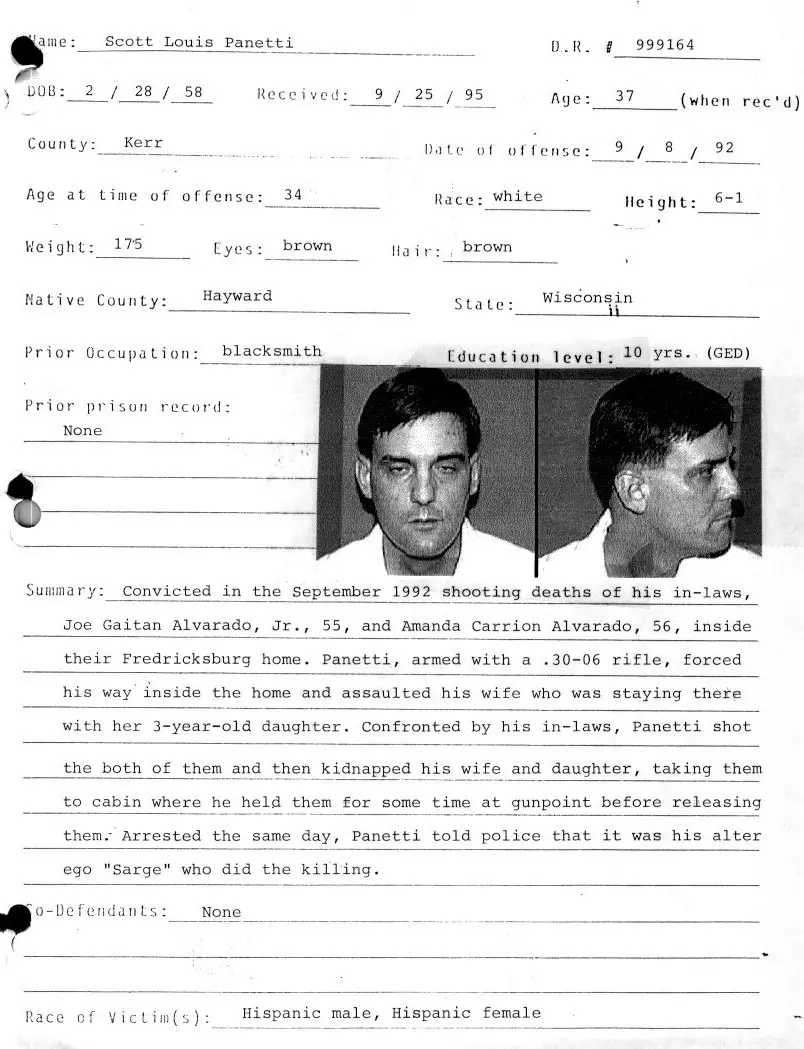
The State of Texas has scheduled the execution of Scott Panetti for December 3, 2014, despite the fact that Mr. Panetti has been diagnosed to suffer from both schizophrenia and schizoaffective disorder.

During his criminal trial, there was quite a bit of hoopla as Scott Panetti represented himself at trial, appearing before the court in what looked to be a cowboy outfit.

Things became more bizarre as he wanted to put the Pope as well as Jesus Christ, President John F. Kennedy, and Anne Bancroft on the witness stand for examination. 

nbsp;


We’d be hard pressed to find anyone who wouldn’t agree that Scott Panetti is mentally ill.

However, the State of Texas has a test for whether or not someone can be execution that allows Panetti’s capital punishment to go forward. The State’s argument is that since Panetti has been shown to recognize a logical connection between the crime that he committed and the punishment that has been assessed as a result (death), then the execution can legally go forward without violating federal constitutional prohibitions against executing someone who is mentally ill.

This has been a long fight.

Panetti’s case has already been before the United States Supreme Court once: the High Court stayed his execution then on the grounds that the State had failed to consider Panetti’s history of mental illness (which goes back many years).  

For those interested in this subject, the amicus curaie brief filed by the American Psychological Association before the Supreme Court on behalf of Scott Panetti can be read online here. 

Moving once again through the court system, the State won arguments before appellate panels that Panetti is indeed legally competent under the Texas definition.

Last month, the U.S. Supreme Court denied Panetti’s request to look at his case a second time.

This week, Panetti’s lawyers have filed more arguments here in Texas trying to stop this execution from happening.

Surely justice will prevail. 

As we discussed before, there has been a challenge to the use of drugs purchased overseas in executions undertaken by various states.  (Specifically, the use of sodium thiopental purchased by Georgia from a questionable British supplier.)

However, news this week has it that in response, the federal government has been going around and grabbing up all the sodium thiopental in the country.  Apparently, the DEA is going state to state and confiscating any sodium thiopental in their inventories.  Wow.

According to Fox News, this has been going on for the past 60 days or so – and it’s leaving states with the option of putting a hold on executions or opting for alternative drugs.  Like pentobarbital, which we’ve discussed before is the same drug used by vets to euthanize pets.

Fox New reports that the DEA began in Georgia, in March.  Next up: Tennessee and Kentucky.  The Wall Street Journal reveals that Alabama turned theirs over to the DEA in the last week of April. 

Now, the DEA (Drug Enforcement Agency) is part of the U.S. Department of Justice, helmed by Attorney General Eric Holder.  The number one prosecutor for the federal government. 

So, a prosecutor is pulling sodium thiopental from execution facilities and leaving the executioners to their own devices – find other ways to carry out the death sentence or freeze the execution schedule. 

It gets even more bizarre. 

As Human Events points out, the DEA is going around grabbing up a drug approved by the FDA to be used in a procedure sanctioned by the U.S. Supreme Court. 

Here’s a question:  When is someone in the federal government going to do something about the growing use of pentobarbital in executions? 

Pentobarbital, which hasn’t been vetted for use on humans. Pentobarbital, which has been okayed for use on humans by the Supreme Court. 

All this morning, there have been almost minute by minute updates on the web regarding whether or not the appellate attorneys feverishly fighting to stop this morning’s execution of Kenneth Biros by the State of Ohio will be successful.  Biros’ attorneys are literally banging on the doors of the United States Supreme Court, asking that the highest court in the land act immediately to stay the execution of Ken Biros — who is set to die this morning  (the execution is scheduled for 11 am) unless something BIG happens.  And this needs to be stopped.  We’ve already written here about all the reasons why. The State of Ohio is about to execute a man in the same way that the vet down the street “executes” pets everyday – by a single, massive injection of a drug.  As we’ve posted about before, no one knows how a human being will react to this procedure.  It hasn’t been scrunitized in the standard legal way — Ohio is allowing Biros to be a guinea pig.  Will this be cruel and unusual?  We don’t know. The New York Times legal blog has periodic updates.  A local TV station in Ohio has a reporter at the prison.  The Tribune Chronicle in Lucasville is posting almost minute by minute events as they transpire.    At 9:20 am, prison officials announced that the execution might be delayed – Ohio would wait until the United States Supreme Court ruled on the defense attorneys’ last minute request.  At 10:00 am, it was announced that the United States Supreme Court will not stop the killing of Kenneth Biros by an unvetted execution method.  Ken Biros will die today.  And the horror exists — if this single injection method is later shown to be legally unacceptable as a method of executing humans, there will be no way to help Mr. Biros.   May God have mercy on us all.