In Fall 2018, SCOTUS will consider two cases that deal with the death penalty:

1. Bucklew v. Precythe

Bucklew v. Precythe, SCOTUS Docket No. 17-8151, asks SCOTUS to consider if the medical condition of a Death Row Inmate can cause the lethal injection method of execution to be “cruel and unusual” punishment in violation of the Eighth Amendment.

Issues Presented

  1. Should a court evaluating an as-applied challenge to a state’s method of execution based on an inmate’s rare and severe medical condition assume that medical personnel are competent to manage his condition and that the procedure will go as intended?
  2. Must evidence comparing a state’s proposed method of execution with an alternative proposed by an inmate be offered via a single witness, or should a court at summary judgment look to the record as a whole to determine whether a factfinder could conclude that the two methods significantly differ in the risks they pose to the inmate?
  3. Does the Eighth Amendment require an inmate to prove an adequate alternative method of execution when raising an as-applied challenge to the state’s proposed method of execution based on his rare and severe medical condition?

Read the Petition for Writ of Certiorari.

Read the Amicus Curaie Brief filed by the American Civil Liberties Union.

Underlying Facts

Russell Bucklew suffers from a congenital medical condition that may well cause him to hemorrhage during any execution involving lethal injection where he would potentially choke on his own blood.

Mr. Bucklew offers the alternative execution method of death by nitrogen hypoxia.

He also requests that to be informed of the medical qualifications of two executioners (members of the Missouri lethal injection team).  Bucklew alleges they may not have the qualifications necessary for the position of lethal injection executioner.

Oral Argument

Bucklew is scheduled for oral argument on November 6, 2018.


2.  Madison v. Alabama

Madison v. Alabama, SCOTUS Docket No. 17-7505, asks the Supreme Court to consider whether or not it violates the federal constitution to allow an individual to be executed when he or she cannot remember the crime for which they have been sentenced to death.

Issues Presented

  1. Consistent with the Eighth Amendment, and this Court’s decisions in Ford and Panetti, may the State execute a prisoner whose mental disability leaves him without memory of his commission of the capital offense? See Dunn v. Madison, 138 S. Ct. 9, 12 (Nov. 6, 2017) (Ginsburg, J., with Breyer, J., and Sotomayor, J., concurring).
  2. Do evolving standards of decency and the Eighth Amendment’s prohibition of cruel and unusual punishment bar the execution of a prisoner whose competency has been compromised by vascular dementia and multiple strokes causing severe cognitive dysfunction and a degenerative medical condition which prevents him from remembering the crime for which he was convicted or understanding the circumstances of his scheduled execution?

Underlying Facts

During the 30 years that Vernon Madison has spent on Alabama’s Death Row, he has had several strokes and now suffers from dementia.  Mr. Madison cannot remember his arrest, his trial, much less the underlying crime for which he was convicted.

Read the Petition for Writ of Certiorari.

Read the Amicus Curaie Brief submitted by the American Psychological Association.

Oral Argument

Madison was argued on October 2, 2018.  Read the oral argument transcript here.
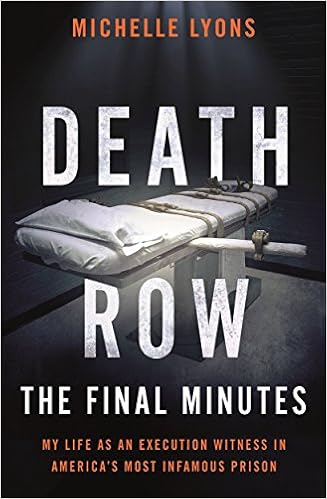
Death Row: The Final Minutes by Michelle Lyons  is a book that you may want to read, no matter your position on the death penalty.  It’s a well-written memoir (consistent 4.5 and 5 star reviews, if that’s important to you).

Lyons Witnessed Hundreds of Executions

Michelle Lyons was an eyewitness to almost 300 executions by lethal injection by the State of Texas.  Part of the time, she did so as a reporter.  For the rest of the deaths, she was there as the media representative (spokesperson) for the Texas Department of Criminal Justice.

She watched the inmates die, time and time again.  She also grew to know many of these men and women, as well as the staff who had the horrific responsibility of carrying out the execution.  (As did her friend and predecessor Larry Fitzgerald, who figures prominently in the book).

For those interested in capital punishment, reading what Michelle Lyons has to tell us about her knowledge and perspective regarding the death penalty, the lethal injection method of execution, and how it impacts so many people is important.  


Book Description From Amazon

First as a reporter and then as a spokesperson for the Texas Department of Criminal Justice, Michelle was a frequent visitor to Huntsville’s Walls Unit, where she recorded and relayed the final moments of death row inmates’ lives before they were put to death by the state.
Michelle was in the death chamber as some of the United States’ most notorious criminals, including serial killers, child murderers and rapists, spoke their last words on earth, while a cocktail of lethal drugs surged through their veins.
Michelle supported the death penalty, before misgivings began to set in as the executions mounted. During her time in the prison system, and together with her dear friend and colleague, Larry Fitzgerald, she came to know and like some of the condemned men and women she saw die. She began to query the arbitrary nature of the death penalty and ask the question: do executions make victims of all of us?
An incredibly powerful and unique look at the complex story of capital punishment, as told by those whose lives have been shaped by it, Death Row: The Final Minutes is an important take on crime and punishment at a fascinating point in America’s political history.


Last week, the Pew Research Center released research findings in an article written by John Gramlich, entitled “11 states that have the death penalty haven’t used it in more than a decade.”  It’s an interesting read, considering that two states recently geared up their Execution Calendars again:

Until this month, Nebraska had not executed a Death Row Inmate in 21 years.  Tennessee’s August 2018 execution was its first in almost nine years.

Execution Schedule Versus Death Row Sentence

Once someone is sentenced to death, he resides on Death Row in the jurisdiction of his conviction.  Whether or not the death sentence is carried out is a different matter from being sentenced to die.

For instance, the federal government also allows for capital punishment, but no one has been executed under federal law since 2003.  California’s Death Row is notorious for holding a growing population, while no one has been executed in California since 2006.

Consider this Pew Research Center graphic:  those in the darker brown are jurisdictions with Death Rows but no executions carried out for 15 years or more:


Most states have the death penalty, but significantly fewer use it regularly

There are several reasons for these growing Death Row populations; we’ve delved into California before, for instance.

However, there appears to be a growing return to active execution schedules in the United States, in what Justice Sotomayor deems a “rush to execute.”  These two August 2018 deaths involved very controversial lethal injection protocols, and there is a concern that using drugs like fentanyl or midazolam is cruel and unusual punishment.

Untested Drugs in Execution Procedures: The “Rush to Execute”

While Tennessee was allowed to proceed, it was not without warning.  Ponder Justice Sotomayor’s dissent in SCOTUS’s denial of a stay of execution for Billy Ray Irick (emphasis added):

As to the prediction that this Court would deem up to 18 minutes of needless torture anything less than cruel, unusual, and unconstitutional, I fervently hope the state courts were mistaken. At a minimum, their conclusion that the Constitution tolerates what the State plans to do to Irick is not compelled by Glossip, which did not categorically determine whether a lethal injection protocol using midazolam is a constitutional method of execution. See Arthur, 580 U. S., at ___ (opinion of SOTOMAYOR, J.) (slip op., at 12). Glossip’s majority concluded only that, based on the evidence presented in that case, there was no clear error in the District Court’s factual finding that midazolam was highly likely to prevent a person from feeling pain. Ibid. (citing Glossip, 576 U. S., at ___ (slip op., at 16)).

As noted, the trial court here came to a different factual conclusion based on a different factual record, as have others. See McGehee, 581 U. S., at ___ (opinion of SOTOMAYOR, J.) (slip op., at 2) (noting a district court’s “well-supported finding that midazolam creates a substantial risk of severe pain”); Otte v. Morgan, 582 U. S. ___ (2017) (SOTOMAYOR, J., dissenting from denial of application for a stay and denial of certiorari) (similar).

If it turns out upon more sober appellate review that this case presents the question, I would grant certiorari to decide the important question whether the Constitution truly tolerates executions carried out by such quite possibly torturous means. 

In refusing to grant Irick a stay, the Court today turns a blind eye to a proven likelihood that the State of Tennessee is on the verge of inflicting several minutes of torturous pain on an inmate in its custody, while shrouding his suffering behind a veneer of paralysis. I cannot in good conscience join in this “rush to execute” without first seeking every assurance that our precedent permits such a result. No. M1987–00131–SC–DPE–DD (Lee, J., dissenting), at 1.

If the law permits this execution to go forward in spite of the horrific final minutes that Irick may well experience, then we have stopped being a civilized nation and accepted barbarism. I dissent.

The State of Tennessee has the execution of Tennessee Death Row inmate Billy Ray Irick scheduled for August 9, 2018.  Irick’s defense lawyers are working very hard to stop this from happening.

This case is yet another example of the importance of zealous, aggressive, and experienced Death Penalty Defense attorneys during the investigation and initial trial of someone for whom the state is seeking capital punishment.  When the defendant suffers from mental illness, there must be an extensive effort made to delve into his childhood (from his earliest days forward), as well as gathering expert analysis of his mental state at the time of the alleged capital crime.

Terry Lenamon is not involved in this Tennessee case.  For more regarding the issues including investigation and presentation of mitigating factors involving psychological issues in:

Battleground No. 1: Method of Execution

Irick’s lawyers are arguing against the method of execution on one battleground.  This week, they filed arguments against the lethal injection method of execution that Tennessee is planning on using in Irick’s execution.  For details, read “Attorneys Seek Stay of Execution for Billy Ray Irick,” written by Steven Hale and published on July 30, 2018, in the Nashville Scene.

Read the full 110 page Motion to Vacate Execution Date filed with the Tennessee Supreme Court here.

Battleground No. 2:  Mental Illness and Assistance of Counsel

There is no controversy regarding whether or not Billy Ray Irick raped and murdered 7 year old Paula Dyer in 1986, a crime for which he was convicted and sentenced to death.  He confessed shortly after he was arrested.

The issue today is the longstanding mental illness suffered by Billy Ray Irick, and the questionable actions of his lawyers during both the guilt and sentencing phases of his criminal trial.  For instance, no defense witnesses were called during the trial phase.  None.

From the Appellant’s Brief filed in 2010 on behalf if Billy Ray Irick we know that while some factual evidence was presented during the trial of Billy Ray Irick’s mental state, it was not entered during the trial phase but during sentencing.  This consisted of testimony provided by or through Nina BraswellLunn, a clinical social worker at the Knoxville Mental Health Center.  It covered the limited time period between Irick being six and eight years old.  That is it.

It was not until after Billy Ray Irick was sentenced to die and the appellate process began that evidence of Irick’s hallucinations and recurring psychosis was discovered.  Indeed, at the time of the crime itself, witnesses provided sworn testimony that Irick was “hearing voices” and obviously mentally ill.

None of this was presented to the jury given the responsibility of deciding between life and death in sentencing.

Accordingly, based upon the evidence of his continuing and severe mental illness, including his mental state on the day of the crime, his defense team continues their fight to stop the execution of Billy Ray Irick.

From their 2010 brief, page 56-57:

Though great deal of time has elapsed since Irick’s original trial and even since the discovery of the Jeffers information, as explained above, Irick and his attorneys were in no position to file petition for writ of error coram nobis for the reasons stated above. Therefore, due process requires that the facts presented herein be considered on their merits. When his case is considered on the merits in light of the newly discovered evidence and the opinions of mental health experts, Irick is confident that the only just sentence is one other than death. Therefore, Irick respectfully requests that this court reverse the trial court and enter such order as will relieve him of the sentence of death.

Note:  For an excellent analysis of the current Tennessee situation, read “TENNESSEE PLANS TO RESTART EXECUTIONS BY KILLING A MAN WITH MENTAL ILLNESS,” written by Liliana Segura and published by The Intercept on July 15, 2018.

Real People and Real Families: The Reality of Death Row 

 Recently, the Marshall Project published an article written by Death Row inmate Timothy White entitled, "Why We Can’t Have Nice Things on Death Row."  Mr. White resides on the North Carolina Death Row, located in Raleigh, North Carolina’s Central Prison.  

It’s a good read and a well-written piece.  

Documentary Series on Death Row

However, for those interested in more details about how Death Row works, there is also a series of BBC documentary episodes being provided by National Geographic Channel and Fox

Check out the details here.  

These are collected under the name "Life and Death Row," and they delve into different aspects of the realities of Death Row in this country.

For instance, Season One’s Execution is an episode that deals with two of the youngest men living on Death Row in Texas.

Season Two has an episode where Texas Death Row inmate named Daniel Lopez works to stop any attempts to stay or thwart his execution. (Mr. Lopez was executed in 2015).

Season Three devotes one episode to how the impending execution date impacts not only the inmate but their families.  Will the lethal injection work properly, wonders the sister of Jack Jones.  

There are more.  These are well worth your time if you want to understand how Death Row impacts so many people, in so many horrific ways.  

Here’s an excerpt from "The Day Before:" 

http://channel.nationalgeographic.com/u/kcD4jK5JPSw6U_cXREmbHsMBywAEe1LYdj1Zu5l-s2E7QDckDq1fWmjHzHORbZR8HH5LV7iAWKs/

This week, the State of Oklahoma announced that it is forgetting all about lethal injections because it has not been able to get the necessary toxic drugs to use for executions.

Gas Chamber in Oklahoma

Oklahoma’s going back to nitrogen.  That’s right.  The gas chamber will be the method of execution in the State of Oklahoma from now on.

Tennesee and Arkansas

Meanwhile, the Tennessee Supreme Court just nixed the Tennessee Attorney General’s request to hurry up and schedule eight men to die before June 1, 2018.  That’s the expiration date of the state’s supply of one of its lethal drugs needed for its lethal injection cocktail. 

Brings to mind Arkansas last year, when it had a problem with its midazolam and tried to execute 8 men in less than two weeks. 

See: Arkansas Plans 8 Executions in 10 Days: Two at a Time

How Much Longer for Lethal Injection Executions?

Which begs the question, how much longer are we going to have lethal injection executions in this country?  How fast are states going to follow Oklahoma’s lead?

See: Firing Squad, Gas Chamber, Electrocution for Executions?

 This week, the Supreme Court of the United States declined to consider the case coming out of Texas, where Death Row inmates petitioned SCOTUS to review their claims that Texas’ use of pentobarbital in lethal injection executions is cruel and unusual punishment.

Seems Texas has a stash of pentobarbital that it got from a compounding pharmacy and Texas isn’t sharing the identity of its drug supplier.  One key factor here:  how old is this stuff, and how far beyond its expiration date.  

Given that the High Court’s action this week, it appears the Lone Star State is free to proceed with lethal injections using its secret drug stash.  Ditto other states with similar Death Row drug pantries.  (At least for now.)

See: Texas Has A Top-Secret Execution Method

Executioner’s Drug Supply

What’s happening here?  For states that approve of capital punishment, there’s a growing crisis because they are finding it harder and harder to get the drugs needed for their execution protocols. The inmate is scheduled to die by lethal injection, but that’s only going to happen if they’ve got the drugs.

Either the big drug companies are refusing to supply executioners with the drugs, or Big Pharma simply stopped manufacturing them.  

See Pfizer Bans Use of Its Products in U.S. Executions

States have tried to find solutions to their supply problem.  Some looked to foreign markets.  Attempts to shop overseas have been thwarted by the Department of Justice. 

See DEA is Grabbing Up All the Sodium Thiopental? No Wonder Pentobarbital Is Popular in Executions

Others tried to change the lethal drug cocktail recipe.  In order to continue executing under the lethal injection method, there were some who altered the drugs contained in the traditional lethal three-drug cocktail.  Others tossed out the idea of a cocktail and went forward with a single drug protocol as an execution device. 

So, when states can find lethal execution drugs, it’s a big deal.  They place big orders so they have a secure supply for the future.  And they keep their suppliers secret, worried that others will pressure the supplier to stop providing execution drugs or that these suppliers will be snapped up by competing states in need of lethal drugs themselves. 

Consider Missouri. 

Back in 2014, Missouri grabbed a bunch of phenobarbital and held it as its lethal execution inventory.  The supplier’s name was given a code to be used in official documents to keep the identity of the pharmacy secret.

Of course, lawsuits were filed to try and reveal the supplier’s identity.  Many of these suits were filed by Death Row inmates seeking to know who the source of their chemical executioner. 

Recently, BuzzFeed revealed that Missouri’s drug supplier is a pharmacy named Foundation Care.  Seems Foundation Care has a reputation for “hazardous pharmaceutical procedures” – but whether or not it’s still available as a supplier of execution drugs is in doubt. 

The compounding pharmacy was purchased by Centene Corporation, and in the BuzzFeed report Centene insists that “Foundation Care has never supplied, and will never supply any pharmaceutical product to any state for the purpose of effectuating executions.”

Nevermind that BuzzFeed has 2 sources confirming Foundation Care supplied the lethal drugs for 17 Missouri executions.

So, has the source dried up?  Dunno. How much does Missouri have in its execution pantry?  Dunno.

Read the complete BuzzFeed expose, written by Chris McDaniel, entitled "The Secretive Company Behind Missouri’s Lethal Injections." 

What Happens Next?

Something else to consider here:  if the states cannot find lethal drugs, or they cannot use the drugs they have, then will this stop the executions? 

Or will it push states to consider older execution methods, which are still legally available to them like the electric chair, gas chamber, firing squad, or hanging?

See:


 The Marshall Project has published its analysis of the state of the Death Penalty as we enter into 2018.  See, "What to Know About the Death Penalty in 2018," by Maurice Chammah of the Marshall Project and published in the ABA Journal.

It’s a good read. Taking everything that has happened – and which we know will be happening this year (like the pending SCOTUS decisions), the Marshall Project has collected them into four specific areas:

1. The Supreme Court of the United States

There’s a great discussion on what might happen if Justice Kennedy retires.  And while Florida is still dealing with Hurst v. Florida, and now we’ve got Hidalgo v. Arizona pending before the High Court.  

See:  "Will SCOTUS Hear Hidalgo v Arizona and End the Death Penalty?"

2. The Attorney General for the United States

Attorney General Jeff Sessions is all for the death penalty. That’s not news.  But the article has some interesting discussion on his dropping of the death penalty back in Alabama.  And how there is a way Sessions could "speed up executions in the states."

3. The States (Florida and Texas playing a big part here)

Big issue here, really, is getting those lethal injection drugs in order to carry out executions.  The Marshall Project points to fentanyl being used, and how the FDA blocked importing drugs from India.

See:

 4. The Counties in those States 

There are certain counties in Florida and Texas that are hot beds for death penalty issues.  Among them, the state attorneys prosecuting cases in Tampa and Orlando.  Can they implement their own ban on capital punishment simply by failing to file a notice of intent to seek the death penalty?  

Another interesting thing to ponder in the Marshall Project synopsis:  what about life without parole? How merciful is it, or it is just as cruel as death, or even more so?  

This week in Florida, there were two major events involving capital punishment in the Sunshine State.

1.  Asay Execution With Etomidate

First, the execution of Florida Death Row inmate Mark James Asay was carried out on August 24, 2017.

This was the first execution by the State of Florida in over 19 months.  Executions have been on hold in Florida after the SCOTUS decision in Hurst ruled the Florida capital punishment statute unconstitutional.

It was also the first execution to use a new three-drug lethal injection protocol, as the Asay execution involved the use of the drug etomidate.

2.  Lack of Unanimity Denies State the Death Penalty in Kendrick Silver Trial

This week, the capital murder trial of Kendrick Silver when to a jury in Miami.  And because one single juror could not agree that Silver should be executed for his crimes, there can be no death penalty in his case.

This is the first death penalty case that has been tried to completion in Miami since the new Florida death penalty law was passed by the Florida Legislature  earlier this year.  

The new statute had to be passed into law because of the SCOTUS decision in Hurst.  

Under the new law, which requires all the jurors agree on the death penalty as the appropriate sentence, the power of a single juror is great.  As is shown in this case, where the hold-out juror found that there were sufficient mitigating circumstances to shield the defendant from death.

Foe more on mitigation in a death penalty case, read:


Of course, the biggest result of the Florida Supreme Court’s decision this week in Asay v. Florida is its failure to block the impeding execution of Mark James Asay.  

Read the full opinion here: Asay v. State, No. SC17-1400 (Fla. Aug. 14, 2017).

Asay Execution Remains Scheduled for August 24, 2017

The State of Florida has scheduled this execution for August 24, 2017.  This week’s Florida Supreme Court opinion will not block that from happening.

It will be the first execution in the State of Florida in many months (over a year and a half), since executions were halted here after SCOTUS ruled that the Florida death penalty statute was unconstitutional.

Impact on Florida Death Row Inmates’ Review of Death Sentences 

After SCOTUS’s ruling in Hurst v. Florida, the Florida Legislature revised the state capital punishment laws twice.  This year, a new statute became effective that mandates juries be unanimous in their recommendation of a sentence of death.

As we have discussed earlier, one result of the SCOTUS ruling meant that Florida Death Row inmates might have legal arguments for re-sentencing and life sentences on constitutional grounds.

The Asay opinion by the Florida Supreme Court did not agree with Asay’s constitutional arguments — although the sole dissenter, Justice Barbara Pariente, did find merit in them.  Specifically, that the cut-off date for determining which Florida Death Row inmates should be allowed re-sentencing hearings is unconstitutional.  

Justice Pariente dissents, agreeing with Petitioner Asay that all Florida Death Row inmates who were sentenced to death in jury trials without unanimous recommendations for death should get a new sentencing hearing.  

Lethal Injection Protocol for State of Florida

This new opinion in Asay is also important for the Florida Supreme Court’s declination to consider Asay’s arguments about:

(1) the State of Florida’s decision to use a new drug in its lethal injection method of execution (etomidateand

(2) its use of a three drug cocktail and not a single drug in the execution process.